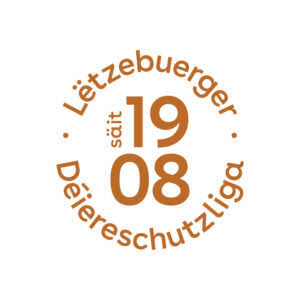
Lëtzebuerger Déiereschutzliga säit 1908 cannot be understood by German public
In an interesting and quite unusual case, Office Freylinger was able to defend the interests of the Luxembourg Animal Protection Association Lëtzebuerger Déiereschutzliga in Germany. We assisted our client in filing a German trademark application for the semi-figurative mark  , which was first refused on absolute grounds by the German Patent and Trademark Office. The German Examiner considered that the German public would have no difficulty in understanding the meaning of the word element “Lëtzebuerger Déiereschutzliga”, due to the similarity of the Luxembourgish and German languages. In the Examiner’s opinion, the trademark applied for consists only of a circular seal print in a usual advertising format, which contains the generic name of a Luxembourg animal protection organization and the year it was founded. Due to the similarity to German, the German public would easily understand the meaning of the word part of the trademark – Luxembourg Animal Protection League – since 1908.
We contested the provisional refusal of the mark and argued that the Luxembourgish word “Déiere” will not immediately be understood by the German-speaking audience as “animals” and that the term “league” is commonly used in German in the context of sports competitions, but not in the sense of “association” or “organization”. Even the word “Lëtzebuerger” will only be understood by German speakers who live close to Luxembourg or have visited the country. Luxembourgish is only spoken in the Grand-Duchy and the border regions of Belgium and France and a German trademark using words of the Luxembourgish language can only be refused if the meaning of these foreign terms is obvious to the German public. The Examiner probably consulted online dictionaries and obtained a correct translation of the words forming the mark, but did not correctly analyze if a German consumer, who does not have access to these tools, would understand the meaning of the expression “Lëtzebuerger Déiereschutzliga säit 1908”. We also submitted that the identical mark had been accepted and registered by the Benelux Office although Luxembourgish is the national language of one of the Benelux countries.
After receipt of our arguments, it took the German Patent and Trademark Office only three days to revoke the provisional refusal and allow the mark for registration.
Trademarks using terms of the Luxembourgish language are common in Luxembourg, but are not often filed outside the Benelux territory and for this reason there is only little case law on the question whether such a mark is sufficiently distinctive if it contains descriptive terms. The case of “Lëtzebuerger Déireschutzliga” shows that it is not sufficient to correctly translate the meaning of the mark, but that it is also necessary to ask if the public will be able to understand this meaning. If this is not the case, there is no reason why Luxembourgish marks cannot be registered in Germany, France or other countries.
Office Freylinger’s trademark team would be happy to assist you in obtaining protection of your trademarks containing Luxembourgish words.
Martin Gutwillinger – European trademark and design attorney