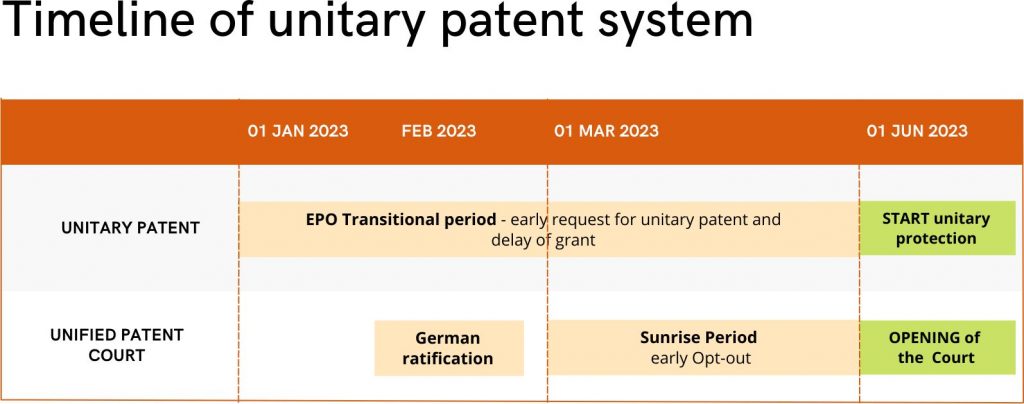
The unitary patent system (or package) has been in force since June 1, 2023. Since then, it has been possible to obtain a European patent with unitary effect, and to bring infringement and nullity actions before the Unified Patent Court.
Office Freylinger keeps you informed about this new system, which is a revolution in the European patent system.
What is the Unitary Patent?
The European patent with unitary effect (Unitary Patent – UP) is a new patent title that confers uniform protection and produces identical effects within the European Union.
Only one annual maintenance fee will be due to the EPO. Economically, this is a great opportunity because the annual fee is equivalent to the cost of annuities in four countries. Translations are also eliminated after a transitional period.
The UP is optional. A company that is granted a European patent can choose between the classic European patent (i.e. validated) or the unitary patent. In the case of the unitary patent, a request for unitary effect must be submitted within one month from grant.
It should be noted that only a number of EU member states are participating in the system: 17 at start, and 18 from 1 September 2024.
What is the difference between a Unitary Patent and a European Patent?
For over fifty years, the European Patent Office has offered a centralized procedure (a single application and examination) for obtaining a patent for all the contracting states (39 to date) of the European Patent Convention.
However, once granted, the European patent transforms into national parts, requiring, depending on the country, the completion of formalities (translations and/or fees) known as “validations”, and the payment of annual maintenance fees. Litigation on validated European patents is traditionally brought before national courts, requiring infringement/validity decisions by country.
The unitary patent is a European patent for which the proprietor has requested unitary effect within one month of grant. No fee is due. It confers uniform protection throughout the European Union (initially 17 countries), without the need for validation.
Litigation (infringement, validity) concerning unitary patents is brought exclusively before the new Unified Patent Court. A decision on infringement can therefore be obtained for all participating member states. Similarly, a revocation decision can be obtained for all participating member states.
What is the cost of the Unitary Patent?
Maintaining a unitary patent requires payment of a single annual fee to the EPO, ranging from €35 for the 2nd year to €4,855 for the 20th year.
The annual fee represents the cost of annual fees in four countries (the most frequently validated). From an economic perspective, this is a significant advantage, as the unitary patent provides coverage in 17 countries for the cost of just 4.
Unitary patent fees are charged after the European patent has been granted. Pre-grant costs remain unchanged, as this is the standard European patent procedure.
What is the Unified Patent Court?
The Unified Patent Court (UPC) is a new supra-national European patent court that has exclusive jurisdiction over European patents granted by the European Patent Office (EPO) for countries having ratified the UPC-Agreement, including infringement and validity actions.
The UPC hence not only has jurisdiction over Unitary Patents, but also over existing (validated) European patents, pending European patent applications and SPCs.
The UPC offers a uniform, specialized, and efficient framework for patent litigation at a European level. The Court comprises a Court of First Instance, a Court of Appeal, and a Registry. The Court is composed of judges from all over Europe. The panels comprise both legally and technically qualified judges with great expertise in patent litigation.
It remains to be noted that there is a transition period of at least seven years, during which national Courts remain competent for validated European patents.
What is an opt-out?
An opt-out is a request to withdraw a validated European Patent from the jurisdiction of the UPC.
An opt-out can be filed in respect of a European patent during the seven-year transitory period that is now in effect and will run until 1 June 2030 (and which may further be extended by seven years).
During this time, opt-outs can be registered for validated European patents and for pending European patent applications.
Once opted out, the patent or application will be subject only to the jurisdiction of the national courts. The opt-out lasts for the lifetime of the patent unless withdrawn by the patentee. If no opt out is filed, the European patent is automatically subject to competence of the UPC.
For the avoidance of doubt, Unitary Patents cannot be opted out.
How many countries does the system cover?
On 1 June 2023, the UPC system has started with 17 EU member states, namely: Austria, Belgium, Bulgaria, Denmark, Estonia, Finland, France, Germany, Italy, Latvia, Lithuania, Luxembourg, Malta, the Netherlands, Portugal, Slovenia, and Sweden.
These are the EU member states that have participated in the reinforced cooperation leading to the creation of the EU regulations and that have ratified the Agreement on the Unified Patent Court.
Other EU member states can join the system at any time. This will however not enlarge the coverage of already registered unitary patents.
Romania will join the Unitary Patent system with effect from 1 September 2024.
Some countries are not yet participating in the UP system, including Ireland, Hungary, Romania, Croatia and Spain.
Non-EU member states cannot participate in the UP system so the UP will not extend to Iceland, Norway, Switzerland, Turkey and, of course, the United Kingdom, which has withdrawn from the UP system due to Brexit.
However, protection in these countries is obtained by validating the European patent, as usual.

Posts on the UP system published before 1 June 2023
Get informed on this subject. Read the information on our website.