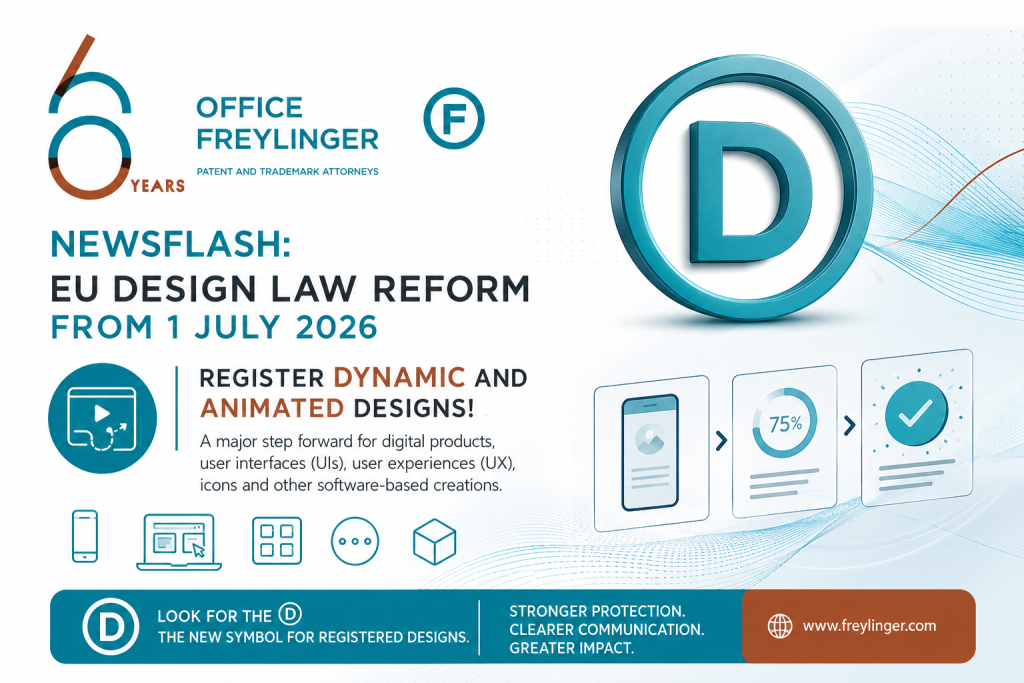
Groundbreaking Changes in European Design Law: Opportunities for Businesses from 1st July 2026 Ⓓ
European design law is facing a comprehensive modernization. Given the rapid digital transformation and the necessity to adapt protection mechanisms to new technologies such as 3D printing and interactive user interfaces, the European Commission has adopted a comprehensive legislative package for the reform of design protection. This package includes the recast of the EU Design Directive (2020/612/EU) and the amendment of the EU Design Regulation (2020/613/EU).
While the amended Regulation, which governs the EU-wide Registered Community Designs (RCDs), enters into force directly, EU member states must transpose the new Directive into their national legislation. For the most significant innovations, particularly the more flexible representation formats for applications at the EUIPO, the regulation will only take effect on July 1, 2026.
This reform offers businesses the opportunity to more effectively protect their creative assets and strengthen their competitiveness in a constantly evolving market.
Design is much more than aesthetics; it is a decisive economic factor. A recent EUIPO survey clearly underscores this: Three out of four European consumers are willing to pay more for better-designed products. This demonstrates the direct added value that outstanding design can generate. Effective protection of these designs is therefore essential to secure this value and prevent imitation.
The upcoming reform significantly modernizes the system and adapts it to the realities of the digital economy.
Key Adjustments and their benefits for every business:
- Flexible Representation of Digital and Dynamic Designs (from July 1, 2026):
- The reform allows for the registration of dynamic and animated designs. This is particularly relevant for digital products, user interfaces (UIs), user experiences (UX), icons, and other software-based creations.
- Applicants will be able to use a broader range of file formats in the future, including 3D files (up to 20 MB per file) and videos (also up to 20 MB). This enables a more precise and comprehensive representation of designs with movement or transitions.
- The previous limitation to seven views will be abolished, which better accommodates the complexity of modern designs, especially in the digital realm.
- More Efficient Application Processes (partially already in force, fully from July 1, 2026):
- It will be possible to combine up to 50 designs in a single multiple application, even if they do not belong to the same Locarno class. This simplifies the application process and can reduce costs.
- Communication with the EUIPO will in future exclusively take place electronically via the user account, leading to faster and more secure processing of applications.
- Expanded Scope of Protection and Increased Legal Certainty (partially already in force):
- The reform strengthens protection against imitation, especially in the digital environment and in the field of 3D printing, by clarifying the protectability of digital elements.
- The definition of “product” is being modernized, so that non-physical objects such as virtual spaces, graphical user interfaces, or lighting installations can now be explicitly protected.
- Introduction of the “D in a circle” symbol: Similar to the “®” symbol for registered trademarks, a new symbol – a “D” enclosed in a circle (Ⓓ) – is being introduced for registered designs. This new visual indicator will allow businesses to clearly mark their registered designs, signaling to the public and potential infringers that the design is protected. This can significantly enhance enforcement efforts and reduce instances of unintentional infringement.
These comprehensive changes offer businesses a unique opportunity to optimize and adapt their design strategy. The ability to comprehensively protect digital innovations can provide a decisive competitive advantage in today’s fast-paced economy.
Would you like to learn more about how these innovations will affect your design protection strategy and how you can best secure your creative achievements? Office Freylinger’s trademark and design team would be happy to advise you on the new possibilities of European design law, both at the EU level and concerning adaptations in national law.
Please contact us to clarify your individual questions and ensure the best possible protection for your Ⓓ designs.