EU Court ruling: “non-alcoholic gin” is no longer allowed

EU Court ruling: “non-alcoholic gin” is no longer allowed

In a recent decision, the Court of Justice of the EU (Case C-563/24) has clarified that a drink with 0%o alcohol cannot be marketed using the term “gin”, even with qualifiers like “alcohol-free” or “virgin”, considering that “gin” is protected under the EU spirit regulation. The term “gin” is thus reserved for spirits with at least 37.5% alcohol and specific production methods and ingredients. Using the term for 0%o beverages is considered misleading for consumers.

The products themselves can still be sold but the word “gin” is now banned on labels and marketing for alcohol-free alternatives.

A major change for anyone in the beverage sector to keep in mind and to consider when creating your marketing campaign.

Do not hesitate to reach out to our experts to check if the names you intend to use are free to use.

”sufficiently fanciful, surprising and unexpected” to be a trademark

”sufficiently fanciful, surprising and unexpected” to be a trademark

The EUIPO’s Cancellation Division declared in a decision dated May 15th, 2025 that “when standard typefaces incorporate graphic design elements into the lettering and these elements have a sufficient impact on the mark as a whole, this gives it a distinctive character”.

The distinctive character of a trademark, also known as distinctiveness, is one of a condition for a trademark to be registered.  The distinctiveness refers to the ability of the trademark to clearly identify the origin of goods or services, distinguishing them from those of competitors. An element of a sign is not distinctive if it is exclusively descriptive of the goods and services themselves or of the characteristics of those goods and services (such as their quality, value, purpose, provenance, etc.) and/or if its use in trade is common for those goods and services. Similarly, an element of a sign that is generic (such as a common shape of a container or a common color) will also lack distinctiveness.

In this case, it is about a trademark using the sole stylized verbal element “NICE”, namely the European Union trademark which covers various ice products including ice creams. The applicant of the cancellation action claimed in its arguments:

  • The word “NICE” has different meanings and on its own will not create a lasting impression of the mark in the consumer’s mind
  • With regard to the contested goods, the public would, therefore, understand the trade mark as a simple claim in the form of ‘pleasant ice cream’, ‘pleasant sorbet’, etc.
  • The fact that the letter ‘N’ in the contested mark is inverted and that the letter ‘I’ has two dots does not alter this assessment

However, when a word is graphically modified causing a consumer to analytically reflect on the meaning of the mark, it will change the consumer’s perception of the word and allow them to associate it with a specific brand, enabling the distinctiveness of a trademark, as the consumer will be able to identify the origin of the goods or services. 

This is exactly what the EUIPO decided in this case to overturn the cancellation applicant’s arguments.

The EUIPO stated that a reversed “N” and a diaeresis “I” is sufficient enough to render the mark distinct due to the unusual combination that an average consumer would not expect, and that the words stylization was enough. It is irrelevant to determine whether the sign ‘NICE’ is descriptive of the contested goods, since the stylisation of the sign is sufficiently fanciful, surprising and unexpected to render the mark distinctive. Therefore, the graphic elements have a significant impact on the contested sign. Consumers will not clearly perceive, without further reflection, that the sign refers to the word ‘NICE’.

This decision is more than welcome and will allow this brand, well known in Luxembourg for ice cream in particular, to continue to delight the taste buds of gourmets while maintaining its monopoly as a trademark.

The lessons here?

  • Adding stylized elements to word elements can considerably increase the distinctiveness and then enable the trademark to be registered

Don’t be shy! Be inventive and style your mark in a way that it starts making you view it in a different light. 

  • A cancellation action for lack of distinctiveness has been filed against your trademark? Do not admit defeat automatically because all is not lost in advance.

Here at Office Freylinger, we can advise you on what makes a trademark distinctive and assist you through all your trademark registration process and cancellation actions

The EUIPO’s Cancellation Division declared in a decision dated May 15th, 2025 that “when standard typefaces incorporate graphic design elements into the lettering and these elements have a sufficient impact on the mark as a whole, this gives it a distinctive character”.

The distinctive character of a trademark, also known as distinctiveness, is one of a condition for a trademark to be registered.  The distinctiveness refers to the ability of the trademark to clearly identify the origin of goods or services, distinguishing them from those of competitors. An element of a sign is not distinctive if it is exclusively descriptive of the goods and services themselves or of the characteristics of those goods and services (such as their quality, value, purpose, provenance, etc.) and/or if its use in trade is common for those goods and services. Similarly, an element of a sign that is generic (such as a common shape of a container or a common color) will also lack distinctiveness.

In this case, it is about a trademark using the sole stylized verbal element “NICE”, namely the European Union trademark which covers various ice products including ice creams. The applicant of the cancellation action claimed in its arguments:

  •  The word “NICE” has different meanings and on its own will not create a lasting impression of the mark in the consumer’s mind
  • With regard to the contested goods, the public would, therefore, understand the trade mark as a simple claim in the form of ‘pleasant ice cream’, ‘pleasant sorbet’, etc.
  • The fact that the letter ‘N’ in the contested mark is inverted and that the letter ‘I’ has two dots does not alter this assessment

However, when a word is graphically modified causing a consumer to analytically reflect on the meaning of the mark, it will change the consumer’s perception of the word and allow them to associate it with a specific brand, enabling the distinctiveness of a trademark, as the consumer will be able to identify the origin of the goods or services. 

This is exactly what the EUIPO decided in this case to overturn the cancellation applicant’s arguments.

The EUIPO stated that a reversed “N” and a diaeresis “I” is sufficient enough to render the mark distinct due to the unusual combination that an average consumer would not expect, and that the words stylization was enough. It is irrelevant to determine whether the sign ‘NICE’ is descriptive of the contested goods, since the stylisation of the sign is sufficiently fanciful, surprising and unexpected to render the mark distinctive. Therefore, the graphic elements have a significant impact on the contested sign. Consumers will not clearly perceive, without further reflection, that the sign refers to the word ‘NICE’.

This decision is more than welcome and will allow this brand, well known in Luxembourg for ice cream in particular, to continue to delight the taste buds of gourmets while maintaining its monopoly as a trademark.

The lessons here?

  • Adding stylized elements to word elements can considerably increase the distinctiveness and then enable the trademark to be registered

Don’t be shy! Be inventive and style your mark in a way that it starts making you view it in a different light. 

  • A cancellation action for lack of distinctiveness has been filed against your trademark? Do not admit defeat automatically because all is not lost in advance.

Here at Office Freylinger, we can advise you on what makes a trademark distinctive and assist you through all your trademark registration process and cancellation actions

UK maintains the exhaustion of intellectual property rights regime, known as UK+

UK maintains the exhaustion of intellectual property rights regime, known as UK+

The UK’s exit from the EU meant that it no longer had to follow the EU’s exhaustion laws. Therefore, as of January 2021, the UK no longer implemented the EU exhaustion regime. This opened the door for the UK to review the complicated choice of how the UK’s exhaustion of IP rights mechanism should apply to goods that are first sold in foreign markets. The issue at hand was whether the previous arrangements were in the best interests of the UK’s economy and society.

The UK government’s decision to maintain the UK+ exhaustion rights regime allows UK businesses and consumers to benefit from a choice of goods from across Europe. This means that products protected by IP rights can be bought from across the European Economic Area (EEA) and the UK, and resold in the UK without needing the permission from the IP owners. This decision ensures certainty and stability for those undertaking parallel trade across markets, ensures competition in the marketplace as well as fair access to IP protected goods.  It also gives consumers continued and ready access to these products.

Please feel free to reach out to our Trademark Team for further questions in relation to your trademarks- in the UK, Europe and beyond.

Ⓓid you already mark your registered designs?

Ⓓid you already mark your registered designs?

Starting 1 May 2025, the first phase* of the EU Design Package Reform comes into effect, introducing significant changes to the European design right system.

The reforms aims to:

  • modernize, clarify, and expand design protection, particularly in response to technological advancements and the digital economy including 3D printing age
  • Harmonize the different procedures
  • Facilitate the registration process and reduce the cost

Summary of Modifications to European Design Right Effective 1 May 2025

1. Terminology Updates

  • We will from now on talk about “Registered EU Design” (REUD) , “Unregistered EU Design” (UEUD)and “EU Designs Court”
  • A new design protection symbol Ⓓ will be introduced, similar to ® and ©, to indicate design protection.

2. Broadened Scope of Protection

  • The definition of “design” is expanded to explicitly include movement, animation, and interior/exterior environments (e.g., shop layouts), codifying current EUIPO practice
  • The definition of “product” now covers both physical and virtual products, including graphical user interfaces, virtual objects, and spatial configurations in virtual environments

3. Procedural Innovations

  • The “unity of class” requirement for multiple design applications is abolished. Applicants can include up to 50 designs in a single application, regardless of their classification, offering greater flexibility and cost savings.
  • Deferred publication rules change for new application: the publication fee is abolished, and design holders must now explicitly surrender the design before the end of the deferral period to prevent publication and the deferment fee has to be paid at the rights moment in time, otherwise the design will be published immediately. For pending application, the “old system” remains in place.

4. Fee Structure and Renewals

  • Renewal fees for designs will increase significantly.
  • The new system applies to all designs with a renewal period starting on or after 1 May 2025.
  • The renewal date is calculated starting at the filing date of the design.

5. Repair Clause

  • Component parts of complex products will not be protected if used solely for the purpose of repair to restore the original appearance of the product, provided their appearance is dependent on that of the complex product (the transitional clause becomes permanent).

The changes collectively modernize the EU design right system, making it more accessible, efficient, and better suited to the realities of digital and global markets.

Don’t hesitate to contact our experienced Design Attorneys Marie-Christine SIMON and Eugénie DESMET, to obtain more information on the protection of your designs under the new legislative framework and to benefit from these amendments.


*Further changes are foreseen to enter into force on 1st July 2026. The deadline for transposition of the new Directive into national law expires on 9th December 2027.

Celebrating Excellence in IP Law – WRT 1000 in 2025

Celebrating Excellence in IP Law – WRT 1000 in 2025

We are proud to announce that Marie-Christine SIMON has been recognized in the World Trademark Review 1000 in 2025 ranking.

WTR 1000 – the World’s Leading Trademark Professionals – a unique guide that identifies the top trademark professionals in key jurisdictions around the globe. The WTR 1000 focuses exclusively on trademark practice and has firmly established itself as the definitive ‘go-to’ resource for those seeking world-class legal trademark expertise.

Celebrating Excellence in IP Law – IAM 300 strategy

Celebrating Excellence in IP Law – IAM 300 strategy

We are proud to announce that Philippe Ocvirk has been recognized in the IAM 300 World’s Leading IP Strategist 2024 ranking.

An annual research project that identifies top practitioners who are taking IP portfolio management to the next level. These individuals are leading the way in developing and implementing strategies that maximize the value of IP portfolios.

Thank you to our clients, colleagues, and team for your continuous support. Let’s keep striving for excellence together!

#Congratulations #IAM300 #Intellectualproperty #Excellence #Patents #Trademarks

Celebrating Excellence in IP Law – IP Stars 2024

Celebrating Excellence in IP Law – IP Stars 2024

We are proud to announce that Martin Gutwillinger and Henri Kihn have been recognized as notable practitioners by IP STARS (Managing IP)!🌟✨

We are also proud that Office Freylinger continues to be recognized among the top firms in this ranking.

Thank you to our clients, colleagues, and team for your continuous support. Let’s keep striving for excellence together!

#Congratulations #IPStars #Intellectualproperty #Excellence #Patents #Trademarks

Romania joins the Unitary Patent System

On 31 May 2024, the Government of Romania (RO) deposited its instrument of ratification of the UPCA, which will take effect on 1 September 2024.

A Unitary Patent covers the territories of those participating Member States in which the UPCA has taken effect at the date of registration of unitary effect by the EPO. Hence, Unitary Patents registered as of the date of 1 September 2024 will cover the territory of 18 Member States.

The EPO has now announced that it will accept requests for a delay of the registration of unitary effect, in order to allow proprietors to benefit from the enlarged territorial scope covering Romania.

This is a welcome initiative that will make sense for most proprietors.

It is reminded that the request for unitary effect (with translation of the entire patent) must be filed with the EPO no later than one month after publication of the mention of grant of the European patent in the European Patent Bulletin.

Philippe Ocvirk | European patent attorney | UPC Representative

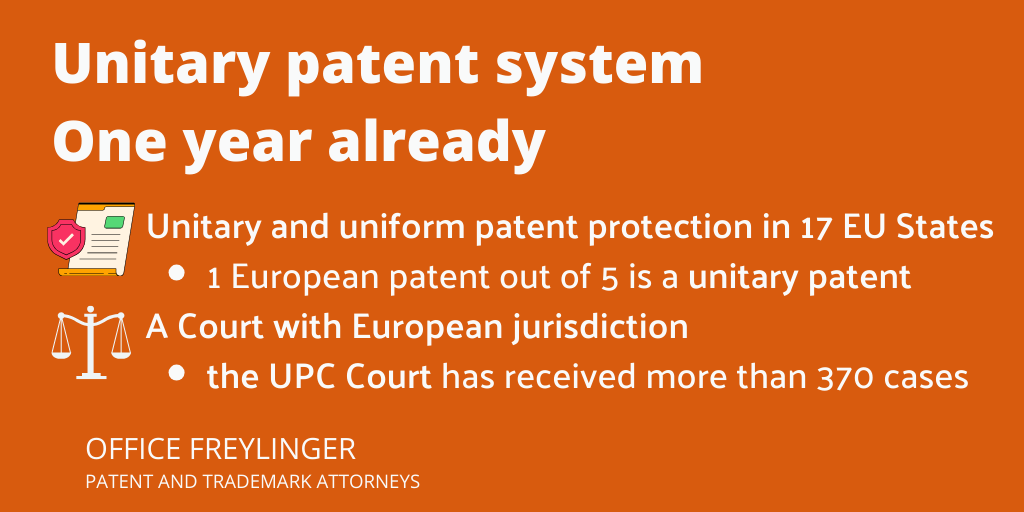
Système du brevet unitaire – 1 an déjà

Système du brevet unitaire – 1 an déjà

Le 1er juin 2023 démarrait le système du brevet unitaire. Après un an, on peut considérer que c’est un succès.

Brevet unitaire

L’Office européen des brevets a opéré une introduction sans failles de ce nouveau titre, qui confère une protection uniforme dans 17 Pays européens.

A ce jour,  28 179 brevets européens à effet unitaire ont été délivrés (1). Cela représente un taux de conversion de l’ordre de 20%. C’est à dire qu’un brevet européen délivré sur cinq est converti en brevet unitaire, plutôt que d’être validé dans les états membres.

Ce sont principalement les entreprises européennes (64%) qui utilisent le brevet unitaire.  

Le 1er septembre 2024, la Roumanie rejoindra le système, portant le nombre d’Etats membres participants à 18.

La Juridiction unifiée du brevet – UPC

La JUB est bien occupée. Le nouveau tribunal a compétence exclusive – pour les états participants – pour l’ensemble des brevets européens (unitaires et validés – sauf opt-out des brevets validés), permettant de régler des conflits à l’échelle européenne en une seule procédure. 

A son premier anniversaire, le tribunal avait reçu 373 affaires (2), parmi lesquelles:

  • 134 actions en contrefaçon de brevet, dont la majorité devant les Divisions Locales allemandes,
  • 165 demandes reconventionnelles en nullité
  • 39 actions en nullité de brevet devant la Division Centrale 
  •  32 actions visant à obtenir des mesures provisoires et conservatoires et des injonctions

La Cour d’Appel, basée à Luxembourg, a quant à elle reçu environ 85 affaires.

L’effet d’harmonisation de la jurisprudence de la JUB  est crucial pour établir la sécurité juridique et la transparence au sein du nouveau système, et offre aux utilisateurs la prédictibilité dont ils ont besoin pour leurs activités économiques.

(1) EPO UP Dashboard – https://www.epo.org/en/about-us/statistics/statistics-centre#/unitary-patent

(2) Case load UPC – https://www.unified-patent-court.org/sites/default/files/upc_documents/Case%20load%20of%20the%20Court_end%20May%202024_final.pdf

Philippe OCVIRK | European patent attorney | UPC Representative

McDonald’s loses chicken ‘Big Mac’ trademark battle

McDonald’s loses chicken ‘Big Mac’ trademark battle

In an article in December 2022 we reported a Decision from the EUIPO Board of appeal, whereby a previous decision cancelling McDonald’s EU Trademark “BIG MAC” had been overturned. In said previous decision the Cancellation division had decided that the evidence of use for the mark “BIG MAC” submitted by McDonald’s had not been sufficient.

But this was not the end of the story and the other party, the Irish fast food chain Supermac’s (Holdings) Ltd. brought the matter before the General Court of the European Union, contesting again the genuine use of the mark “BIG MAC” by McDonald’s. The General Court analysed the evidence of use submitted by McDonald’s in detail and came to the conclusion that McDonald’s had not proven use of the “BIG MAC” trademark in relation to chicken products or services “associated with operating restaurants”. With respect to chicken sandwiches, McDonald’s submitted printouts of advertising posters, screenshots of a television advertisement which was broadcast in France in 2016 and screenshots from the Facebook account of McDonald’s France in 2016, which show use in relation to “BIG MAC” sandwiches of chicken, but in the view of the General Court do not make it possible to ascertain in what quantities, or with what regularity and recurrence, the goods concerned were distributed. The evidence in relation do chicken burgers does furthermore not contain any indications as regards the prices and is thus considered insufficient.

As regards McDonald’s restaurant services, the General Court finds that it would be contrary to Article 15 of Regulation No 207/2009 to hold that use in connection with goods could also prove use in connection with specific services. The evidence which was submitted by McDonald’s does not, in the General Court’s view, serve to prove that the contested mark has been used in connection with ‘services rendered or associated with operating restaurants and other establishments or facilities engaged in providing food and drink prepared for consumption and for drive-through facilities; preparation of carry-out foods’.

As the matter now stands, McDonald’s can maintain the “BIG MAC” mark for the meat sandwiches everyone knows, but will lose trademark protection for chicken sandwiches and restaurant services in relation to this mark.

The “lessons learned” that we indicated in our previous article are still valid, namely:

  • It is not because the mark is widely known that its genuine use will be automatically recognized by the EUIPO. Proof of use should be submitted as for any other trademark. Proof of the use of a trademark must be provided according to certain criteria, the EUIPO not being able to rely on facts that are not submitted to it
  • This case is an opportunity to remind trademarks owners of the importance of collecting regularly relevant documents showing the use of their trademarks to be able to defend their rights within the scope of a non-use cancellation action.

This decision can still be appealed to the EU’s top court, the Court of Justice, but only under very restrictive conditions.

2024 INTA Annual Meeting in Atlanta

2024 INTA Annual Meeting in Atlanta

Philippe Ocvirk and Martin Gutwillinger will be attending the 2024 INTA Annual Meeting in Atlanta!

INTA is the largest gathering of its kind. A unique opportunity to entertain robust conversations and exchange on best practices with more than 10,000 IP specialists from around the world.

Our team is eagerly looking forward to reconnecting with colleagues and making new connections.

Trade mark rights and drug trafficking don’t mix for the EUIPO!

The association of the name Pablo Escobar with drug trafficking by the Spanish public could not allow the name “Pablo Escobar” to be registered as a trade mark, as this could have been perceived as contrary to EU values.

Despite respect for the presumption of innocence of the man who was never convicted, the rejection of the trademark registration on the grounds of public order seems, thus more than justified.